Search

My Kind of Food

Sharing stories about the kind of food I like to eat

Author

Graeme Jolly

Down by the riverside

During my recent stay in the North-East of England, I went, with members of my family, to a 1 Star Restaurant in Newcastle. In fact we went to only Michelin Starred restaurant in the city.

IMG_0575.jpg

I’ve eaten Kenny Atkinson’s food three times now; firstly at Seaham Hall, many years ago where he gained a star, and later at Rockcliffe Hall; both in County Durham.
IMG_0567.jpg

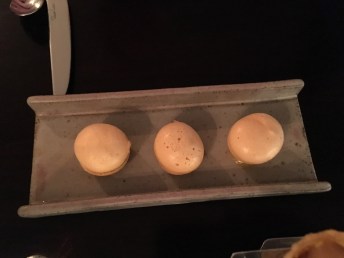
House of Tides is his own place and first gained a star in 2015 and subsequently retained it for 2016 and most recently for 2017.  The restaurant itself is close to the iconic Tyne Bridge and the funky swing bridge.  It’s housed in a former 16th Century merchant’s house which has been converted into what his publicity calls ‘a casual and informal space’.  The ground floor is in what I would call, industrial chic style, complete with rustic tables and chairs; some of the tables were even a bit sticky in the olde-worlde end of the street pub way!   It’s in this area that pre-dinner drinks are served – I had a negroni – and the menu is presented for consideration. Alongside the drinks we were given a serving board of three bite sized gougeres (savoury choux buns).  The gougeres were piped full of unctuous cream cheese with onion chutney and truffle.  I’m a bit funny about truffle, sometimes I like it and sometimes I don’t, so in this case I was content that I couldn’t detect its unique taste at all.

The menu choice, headed, ‘Autumn 2016’, was between a Dinner Tasting and a Vegetarian Tasting.  Interesting to note that the vegetarian option followed the non-veggie one as closely as possible without upsetting the sensibilities of non-carnivores (of which there were none on our table). The gougeres formed the first item on the menu – so far so good!

We were taken upstairs and found our wine and water choices already on the edge of table. Adam our waiter for the evening was introduced to us and proved to be an excellent guide to what we were eating.

It’s worth mentioning here, that, in order to reinforce the casual style the staff wear black jeans and either black or white open-necked shirts.  Customers too were in smart-casual mode, with only one tie seen in the whole place.  To my mind this is a good thing.

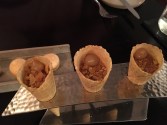
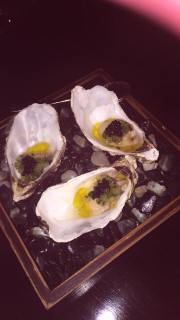
The first course served at the table came in three parts, all put in the centre (three of each).  The first I tried was a small ice-cream cone containing liver parfait and sultanas, with a lovely mild curry flavour; the second a tiny macaron, described on the menu as, Carrot meringue, carrot curd, fennel pollen; the third a fresh oyster from the Holy Island of Lindisfarne with cucumber, ginger and ‘caviar’.  All were lovely and exceptionally fresh tasting but I discovered for myself, that the order in which you eat them is important.  I really wish I’d started with the oyster (the mildest of the three elements), then the parfait, finishing with the macaron.  The macaron was such a dominant flavour it really obscured the oyster which followed.  I’d happily eat a whole pile of them though.  Adam received the feedback with a level of interest that makes the diners feel that they are not just passive consumers of what is laid before them but maybe co-creators of a culianry experience.  So perhaps, in future it wouldn’t do any harm to recommend an eating order for this trio of goodies.
14729316_10154926048814311_9129306378583797593_n.jpg
Lindisfarne Oysters
IMG_0570.jpg
Chicken liver parfait
IMG_0571.jpg
Carrot meringue, carrot curd, fennel pollen

What ever it is that puts food in the one, two or three Michelin star bracket, those little meringues had it.   Intense!

Bread and butter (fermented rye bread and Grant Harrington’s cultured butter) were served alongside a little pot of Butternut Squash with smoked bacon and truffle. Again intensity of flavour was the overwhelming impression of this velvety, creamy soup the bacon bits offering just a touch of bite for contrast.

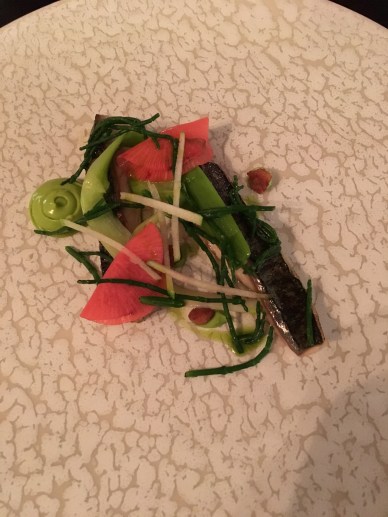
Mackerel is a simple yet lovely fish, especially when served with something a little sour to cut through the oiliness of the fish itself.  In this case the menu promised, Mackerel, artichoke, blackberry.  Ok, so a tart blackberry should be a good foil to the oily mackerel  but I was half way through before I realised there was nothing resembling a blackberry on my plate. Adam, who hadn’t served this course to us, explained that there had been a menu substitution consequently we had mackerel, apple and pickled radish before us.  The pickled radish might’ve offered that sourness I was looking for but sadly, in reality, it didn’t.  The tiny pieces of fish though were very yummy.
IMG_0572.jpg
Mackerel

A little bit here about the service.  I can’t abide an overly obsequious waiting style.  It makes me feel guilty about the fact that someone is waiting on me.  It’s opposite vice, indifference to the needs or wants of the diner, is equally abhorrent.  The staff at House of Tides get it right in my view.  They are attentive (wine glass always unobtrusively topped up), interested to know how we found the food and (apparently) keen to receive constructive criticism.  ‘Our’ Adam in particular was invisible until we needed him, then unfailingly polite and scrupulously professional.  He deserves to go far in his career.

Back to the food!  Next up was the first of two meat courses; in this case, Venison tartare, beetroot, blueberries and kale.  It was a suitably tiny portion, presented in a ‘pile’ on a dark plate. I was intrigued.  Two flavours dominated – blueberry and deep fried kale.  The kale was reminiscent of that so-called ‘seaweed’ you get from Chinese take-aways, which is deep fried shredded cabbage sprinkled with powdered scallops.  I love it.  For the life of me though, once I’d put that morsel of flavour into my mouth and a blueberry, I couldn’t distinguish the taste of the venison at all, nor indeed of the beetroot, which in my view should have provided an earthy flavour.  I’m not sure what the solution to this is, but I hope my feedback makes them think again about this particular combination.

IMG_0573.jpg
Venison tartare

The lamb dish, which followed, did not have the same issues at all.  The testimony to how much I loved this dish is that I didn’t stop eating it long enough to take a photograph! The menus told us it would be, Lamb, broccoli, tomato, radish, and so it was, but that’s only the start!!! The lamb was rump, tongue and sweetbreads.  The rump was beautifully cooked, a vibrant reddish-pink colour and very flavoursome, however, the offal stole the day.  Last time I had (veal) sweetbreads I really didn’t enjoy them and although I love eating cold pressed ox and pork tongue I’d never  before eaten lamb tongue.  The sweetbreads were crispy on the outside and tender on the inside, with just enough firmness to allow you to bite into it before it started to dissolve.  As for the tongue, the tip of the tongue apparently,  I have never eaten anything before that tasted so much of lamb.  When can I eat these lovely things again?

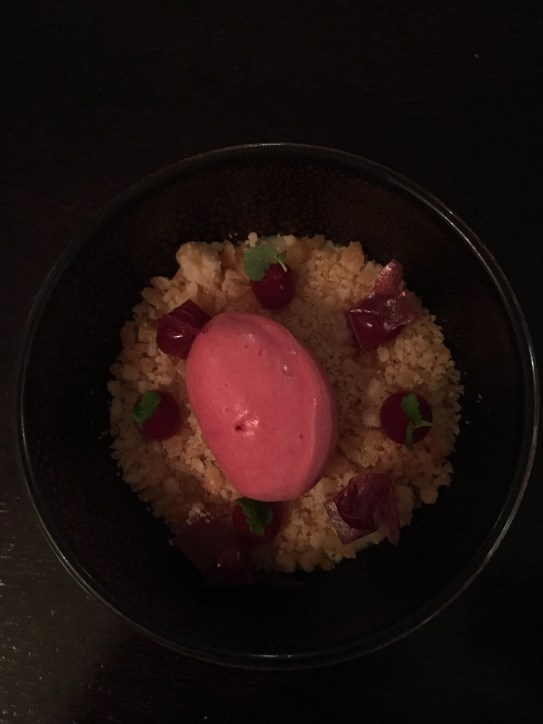
And so to the puddings.  We next tucked into, Raspberry, lemon, pine nuts, which was in fact a light, sharp and delicious lemon posset with a pine nut crumble and raspberry sorbet on top.  Heaven!  The Pear, almond, ginger second pudding was equally delicious and light but by now the over-enthusiastic heating in the dining room was making us tired and longing for some cool, fresh air
img_0574
Raspberry, lemon, pine nuts
14591758_10154926436144311_8344287656147814867_n.jpg
Pear, almond, ginger

So how to sum up?  Not everything was spectacular about House of Tides but on the whole it was a good and enjoyable experience, with some exceptional high points.  The macarons, lamb offal and the posset were to die for.  The atmosphere was suitably relaxed (if a tad warm) and with great service from Adam.  I was less enthusiastic about the venison dish and would’ve preferred the version of the mackerel that was on the menu.  The restaurant’s focus on locally sourced and fresh procure though will mean that sometimes there needs to be last minute menu changes.

Kenny Atkinson, the Chef-patron, wasn’t working the evening I was there so I’m guessing that Danny Parker, Head Chef, was driving.  Thanks to him and his brigade for some lovely food.  I’d need a more frequently changing menu to entice me back next time I’m in the area though and as a returning customer I would probably prefer to have an al a carte option to sit alongside the tasting menu.

Porcini freschi – difficult to beat

Kippered!

Kippers (smoked herrings) are becoming more popular again these days.  I’ve loved them since I was a child when we used to have them ‘boil in a bag’.  They would come in a vacuum sealed packet with a pat of butter inside and then simply be warmed through by placing them unopened in a pan of boiling water for a short while.  Gastrophiles call this sous-vide cooking these days!

Unknown-3.jpeg

There’s not much doubt that the ‘kippering’ of herrings was born on the Northumberland coast, either in the fishing village of Seahouses or Craster, not withstanding the fact that similar products can be found across the North Sea in the Scandinavian countries and also in Eastern Europe.  Craster Kippers though are special and have been described as the best available – and not just by me!  The family firm L Robson & Sons, in Craster, makes Kippers from North Sea Herrings (‘silver darlings’ as they are affectionately known), as they have done for over 130 years.  The fish, only the plumpest, are split, soaked in brine for a while and then smoked for 16 hours over smouldering oak and whitewood.

Unknown-4.jpeg
Grilled Kippers

When I was in Newcastle, UK, recently I went for breakfast to a quirky little cafe in the shadow of the Tyne Bridge, called Quay Ingredient (lovely pun!).  It had been recommended to me as serving the best breakfasts in Newcastle, so I thought I had to give it a go.

It’s a tiny place and was quite busy but I managed to get a table.  The breakfast menu offered a range of different options, from Full English, through various egg based dishes and pancakes, to cereal and toast.  My eyes were immediately caught by ‘Grilled Craster Kipper with Lemon Parsley’ so I ordered it with a cup of black coffee, which was much needed after a heavy and late night!

The kippers have to be the best I have ever eaten.  They were plump and juicy and drowning in lemon and parsley butter and served with generously buttered slices of toast.  The taste was an exquisite mix of smoke, salt, pepper and lemon! The lemon juice was sharp but not bitter and  cut-through the gorgeous salty butter perfectly.   This made me realise just how special Craster Kippers are and also made me appreciate how they can be jazzed up with nothing more than a few simple accompaniments.  Perfect, or ottimo! as we might say here in Italy!

images.jpeg
Quay Ingredient in Queen Street, Newcastle


Good old Newcastle

Newcastle, in the North-east of England is a fascinating city, known in the past for ship-building and football and today, as well as Premiership football, also for the locals not wearing coats when having a night on the ‘toon’.  No matter the weather, T-shirts and short skirts or shorts are the order of the day and the night!  Its also home to Newcastle Brown Ale, a local brew that I’ve drunk all around the world, even as far away as Sydney, Australia.

study-abroad-46217.jpg
Picture form Newcastle University Website

There’s another connection with Sydney and that’s the Tyne Bridge, linking the cities of Newcastle and Gateshead and sitting 59m above the River Tyne.  The bridge was opened in 1928 very close to the site of the Pons Aelius, the very first bridge across the Tyne built by the Romans in the year 122 A.D.  The present bridge was built by a Middlesborough firm, Dorman Long & Co Ltd in the same style as their other, larger work, which opened in 1932 in Sydney.  Having visited both I know which I prefer and it’s the original Geordie version!

Unknown-2.jpeg

The roads rise steeply away from the river in Newcastle, towards the castle and city centre, but in the shadow of the bridge, one block back from the river, is an array of small independent pubs, cafes and restaurants.  They’re in sharp contrast to those that can be found in the more hip Quayside area which are typically large chain bars and restaurants catering for the many stag and hen parties which fill the city at weekends.

My nephew and his girlfriend are good guides to the eateries of Newcastle and, during a recent visit, we went together to a couple of interesting places.  Of note is a very small Thai restaurant, called Old Siam in a road called Side.  It has a sister restaurant, of the same name, in York too.  From what we could see, the waiting and kitchen staff are all Thai, ensuring authenticity in the preparation of the food and in that smiling Thai welcome front-of-house.

It’s a simple place with friendly staff and the food is very yummy indeed, although I suspect the Tom Yum soup is toned down a bit for western tastes. I’m going to remember the soft-shell crab starter I had for a very long time, in fact, next time I go, I’m going to have a double portion as a main course.  The restaurant is open for lunch and dinner and you can also have a takeaway.

14618675_1170112656389163_1377645968_o

The North-east of England, like the North of Italy, has its particular local delicacies and maybe there will be the opportunity to write about some of them on this blog in the future, things like Singing Hinnies, Pease Pudding and Panackelty  For now though, a call out for the Stottie Cake, which despite its name, is a form of bread, not a cake, in the way we understand the name nowadays. Its a flat round loaf 20-30cms in diameter and about 4 centimetres deep with a small indentation in the middle. Its name is associated with the dialect verb to ‘stott’ which means to bounce.  The stottie cakes, if dropped, should therefore bounce!  It’s a true taste of home for north-easterners who’ve moved away and made all the more special because it’s almost impossible to find outside of the region.  Split in half and stuffed with boiled ham and pease pudding or with bacon for breakfast it’s delicious.

img_0590
Stottie cakes exported to Italy – they got a bit squashed in transit.

Come back to the blog soon for more about my recent visit to Newcastle, including my review of a Michelin 1 Star restaurant and breakfast of Craster Kippers!

Off the beaten track in Emilia-Romagna

Almost all Italians are interested in, and passionate about, food.  A typical conversation amongst friends travelling to work together on the train might start about the weather, politics or the economy, with a consequent set of frowns developing on the faces of the interlocutors.  Then all at once someone mentions a particular dish they’d recently eaten and smiles return, the volume increases excitedly  and everyone is at ease, the problems of the world forgotten for a while.

I’m fortunate to have got to know a range of people who travel around Italy for work, often staying over night and therefore needing to eat in out-of-the-way restaurants.  One of these friends is especially good for instant recommendations.  When we last saw each other last Friday I asked him if he knew anywhere to eat that would show-case local food, well prepared, and located midway between Lodi and Bologna.  That would place it in the Emilia-Romagna region, somewhere near to Parma.  It was to be the venue of my meeting up with some friends from the UK who are currently taking a break in Bologna and it’s about an hour’s drive for each of us.

As quick as a flash Massimo named a restaurant and sent me a link on What’sApp.  There was no need to ask detailed questions, I trusted his judgement completely after he’d told me where to eat during the Bra (in Piedmonte) international cheese festival last year. More about the cheese festival on another occasion.

esterno-1.jpg

The restaurant, Ristorante Romani, is in a tiny Borgo (hamlet) to north of the city of Parma.  The only difficulty of the evening was trying to find the way into the restaurant.  Having parked in the car park at the back of the building we headed for the nearest door and discovered first the kitchen, then the staff rest area and finally the loos but no restaurant.  None of the back-room staff seemed at all bothered by us wandering round in circles but eventually we found an external staircase which took us to a very rustic dining room, entirely empty except for gli amici Inglesi who were patiently waiting at a table.

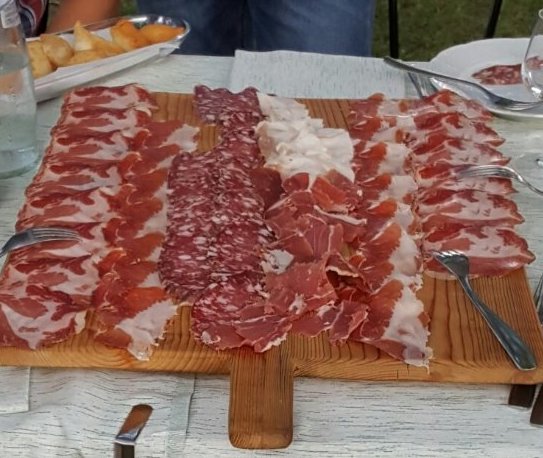
Not being able to decide what to choose from the menu isn’t really a problem in Italy as its often possible to have a little bit of this and a little bit of that and eat ‘family style’ with everyone sharing.  We decided to put off deciding what to order for the pasta and main courses by sharing an enormous platter of cured meats and a plate of the hugest chunks of parmigiana reggiano. On the side we also had two great piles of the gnoccho fritto that I wrote about here.

20160709-204000-largejpg.jpg
Affittato Misto – ours was even bigger!
For the primo (pasta course) we also decided to share, three different ravioli dishes between four of us.  If I say they were nothing out of the ordinary, please understand that they were very good but also quite filling.  Filling enough, in fact that the plan to have secondi (main courses) was abandoned altogether.  The menus offered a number of main course options based around beef, horse and veal belly.  I don’t usually eat horse meat so I would’ve probably opted for the veal but I reluctantly gave in to peer pressure and made do with a soft, yielding pannacotta for pudding, which, along with tiramisu, is one of the staples of any Italian menu, anywhere.

I should imagine this is a lovely place to eat in the summer, with tables set in the courtyard but in any case I’d be happy to go back and eat my way through the rest of the menu.  It’s not the sort of place you would ordinarily find yourself driving past but would be perfect for anyone driving down the Via Emilia or staying in Parma.

A present from Oxford

I met up with some friends from England the other evening in Parma and very gratefully relieved them of a chunk of delicious cheese which they’d brought with them.  I’ll write about the supper we had that evening in a day or two.

The cheese in question was Loch Arthur Cheddar made in Beeswing in Scotland.  It’s a creamy, unpasteurised Cheddar with a great depth of flavour but not too strong or acidic.img_0539 My friends live in Oxford and had procured this taste of the old country from the Oxford Cheese Co.  Looking at their website has made me want to visit them next time I’m in Oxford. They have a huge selection of cheeses from around the world and also tracklements, beers, wines and spirits.  Oh how I wish you could buy good British cheeses here in Italy!

Bread and Dripping at Trembling Bridge

Pontremoli-Stemma2.pngPontremoli (literally ‘Trembing Bridge’) is a small town in the Massa-Carrara province of Tuscany, close to the Ligurian city of La Spezia.  Carrara, of course, is the place where the great artist, Michelangelo came to select the marble he used for his sculptures.
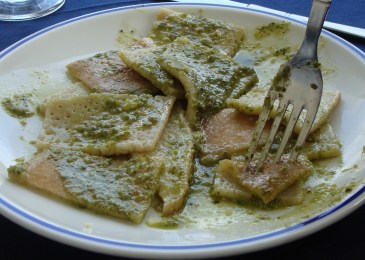
Like most places in Italy it has its own particular dishes, such as torta d’erbe which is a pie made with filo-type pastry and filled with chard, ricotta, eggs and parmesan cheese.  Also famous in this area is testaroli which is the oldest form of pasta known.  It’s a flat, baked pasta cut into small rectangles and commonly served with pesto.

Testaroli-Pesto-Pontremoli-2800.jpg
Testaroli con pesto

The afore mentioned chard is called bietola in Italian and tucked away in one of the tiny alleys of Pontremoli, is a lovely place to eat, Osteria della Bietola.  It’s a small family run establishment and I had Sunday lunch there recently.  The entrance to the kitchen is right by the front door and on arriving it was heartwarming to see the cook bending down and tending to something in the oven with steam and the smell of meat tumbling out of the open oven door before her.  She raised her head to shout a cheery ‘buongiorno’ then returned to her cooking.

The menu consists of a few antipasti, pasta dishes then meat (lamb, beef and rabbit as I recall) cooked in different ways, such as grilled, fried or ‘alla cacciatore’ (a gutsy stew).

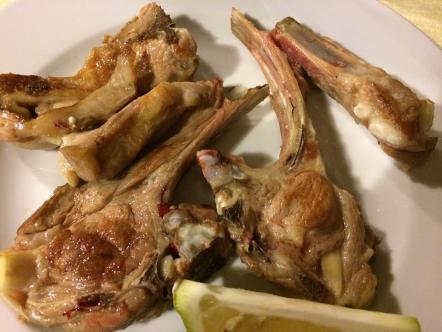
11539627_10153471224835917_4800278658195994167_n.jpg
Grilled lamb chops with squeeze of lemon

For the pasta course I choose homemade ravioli stuffed with bietola and ricotta in a gorgeous meaty ragu.  I followed it with grilled lamb chops accompanied by a plate of soft white beans.  Extremely simple and perfectly tasty!

The highlight though was what came before (the antipasti).  There was some of the torta d’erbe mentioned above, various local cured meats and that most sublime of Italian foods, lardo.

Quite simply, lardo is pig fat that has been cured with salt, herbs and spices.  The best of it comes from Colonnata, which is a district of the city of Carrara.  The fat is traditionally cured in basins made from the famous Carrara marble and it has a long history going back to the days of the Romans.

Unknown-1.jpeg
Lardo di Colonnata

The lardo is sliced very thinly and eaten with bread and can be delicious, as it was on this occasion.  If the bread is warm then the experience is taken to new heights as the fat slowly melts.  It has other uses too, which might be the subject of future posts.  At home I serve it on warm gnocchi fritto, which are puffed up, deep-fried pastry ‘pillows’.  It’s a perfect combination which reminds me of Sunday night suppers as a child, eating pork fat spread on bread, or standing by the oven dipping bread into hot beef-dripping as the Sunday roast rested.

Unknown-2.jpeg
Gnocchi fritto con lardo

If you’re in Pontremoli, give this place a try – its cheap, cheerful and serves perfect home-cooked food.

Address: Via Bietola, 4, 54027 Pontremoli MS, Italy
Phone: +39 0187 831949


Found in a backstreet

img_0505

I had to be in an area of Tuscany called Lunigiana recently and decided to stay the night in the port city of La Spezia, nearby.  In fact it’s not in Tuscany but Liguria.  I was arriving late on Saturday afternoon and would leave early on Sunday morning and hadn’t made any arrangements for eating.  The accommodation I’d booked was well away from the seafront and in fact was in a fairly dull backstreet.  There was no one there when we arrived so it was necessary to wait until someone could come to let us in.  It was then that we noticed a sign indicating an eatery just two doors away (Osteria della Corte).  I wasn’t hopeful, but it had been a busy day and I didn’t have much enthusiasm for traipsing around the streets looking for somewhere to eat later, nor indeed could I be bothered with doing any research on-line.  Somewhere to eat and then get quickly back for a sleep seemed not a bad idea.

On enquiry, it seemed the restaurant was fully booked for dinner but with a little bit of persuasion and the offer to come late, the possibility of a table for two but, “not before 9.30 pm” materialised.  In the meantime a quick look at Trip Advisor and the Michelin Red Guide raised expectations well beyond what was indicated by the location or the exterior of the restaurant.

The initial welcome was from a young waiter who greeted us with a pleasant smile and showed us to our table. The smells from the small kitchen were enticing.

We asked immediately for a bottle of sparkling water while we perused the menu.  The waiter meanwhile busied himself reducing the table setting from a table for four to the needs of two diners.

The menu was very interesting and one where I really found it difficult to decide what to order.  I wanted most of the things on offer!  It was divided into Antipasti, Primi (pasta dishes) Il mare (fish and seafood) and La terra (meat, snails, liver and a vegetarian dish).  The dining room was intimate and well decorated with shelves bearing cookery books and a vast array of bottles of wine.  There was a sideboard with spare sparkling wine glasses in various shapes and sizes next to bottles of delicious looking dessert wines.

With the table re-set for two and our choices made, we wondered what had happened to the water.  The tiniest of gestures to the waiter produced a fulsome apology, followed immediately by the required beverage. I’ve never had a problem with things going wrong in restaurants, it’s normal; the main issue is how quickly, to what extent and with what attitude things are put right.

img_0512

With the order taken, wine chosen (something local, red, well priced and very acceptable) we began to observe the other diners and in particular the dishes they were being served.  Everything looked amazing and the sight of such good looking food made me want to change my own order a dozen times.

I stuck to my guns though and soon three beautifully caramelised scallops (Capesante)  on a courgette and thyme cream (ordered from the Antipasti list) arrived.  They were very simple, succulent and perfectly cooked.


img_0513

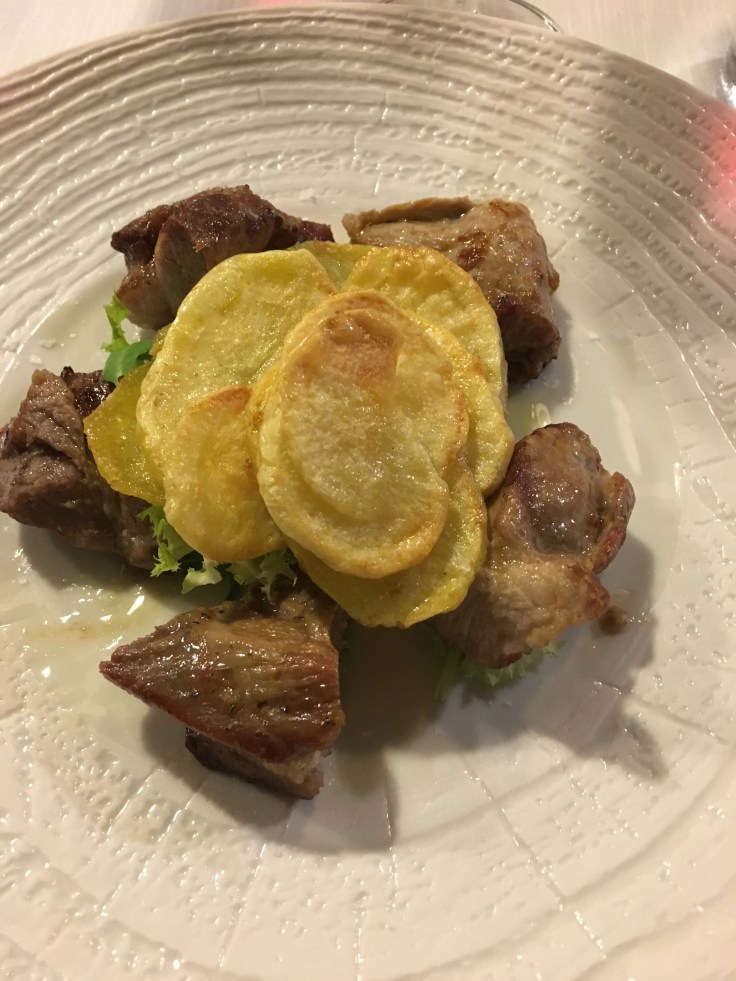
My next dish was from the meat section of the menu, Taglio di maialino di Cinta senese con patate (suckling pig with potatoes).  Cinta di senese, I now know, is a particular breed of pig from the province of Siena and in this case was served it chunks topped by sautéd potato slices.  The meat was beautifully pink in the middle but with equally delicious crunchy bits around the outside, clearly cooked with careful attention.  For my taste the potatoes were a little dry and the meat a little over salted but it tasted properly of meat and with the sort of texture it’s impossible to achieve with the uber fashionable sous-vide method of cooking.


img_0515

For pudding I had a confection of  frozen cream (parfait) with Sichuan pepper, coconut, and liquorice  sauce which was served with a glass of perfectly matched  Passito – faultless!


img_0517

The front of house staff here (two guys) were very keen to hear feedback and and not at all defensive in the face of what I told them about the over-salting of the meat.  They genuinely seemed interested in what we thought and discretely and generously did what they could to put things right – even though we were at pains to point out that we were not complaining.  In any case what minor grumbles I had didn’t stop me scoffing the lot!

I have a number of pet hates when it comes to service in restaurants, one is when waiters who haven’t kept your glass topped up (in any case I can manage that myself) rush to grab the bottle from your hand when you try to help yourself (that wasn’t the case here by the way) and the other is the wearing of gloves by waiting staff.  Here, white gloves were donned whenever the guys brought cutlery or glasses to the table.  Sure it meant everything was gleaming but in my view it’s a tad fussy.

Prices for starters  and pasta are around €15, fish mains about €20 and meat a little bit more with deserts coming in at around €7.  Whatever the cost they represent very good value for money.

Here is a restaurant that has worked out exactly what it is about and strives to deliver high standards of cooking and service in a very pleasing environment.  Inevitably there are occasional errors but they acknowledge them and put them right without question. That’s a very big plus point in my book.

The staff speak good English and Silvia, the chef, also runs cookery courses.  I will return, not only because of their food but because of their attitude.


img_106026-1.jpg

The Great British Cheese!

Sometimes Italian friends react with surprise when I tell them there are some great cheeses originating in the UK.  FromageHomage is all about that!

I can recall the first Christmas party here when I served the King of British Cheese, Stilton.  I think there are still people who don’t believe it was English.  What a pity my Stilton Spoon seems to have been lost in the move.  Maybe Santa Claus/San Nicola/Santa Lucia/Befana will bring me one…


images-2.jpeg
Stilton and Spoon

Blog at WordPress.com.

Up ↑