Search

My Kind of Food

Sharing stories about the kind of food I like to eat

Category

Italy

La Locanda Del Benaco

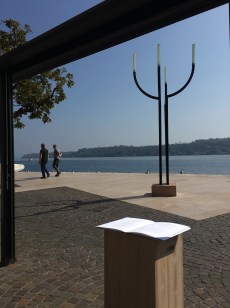
A couple of weeks ago I was able to spend a few hours on the shore of Lake Garda, in a lovely little town called Salò.  Today it’s a quiet sleepy lakeside town but in the heady years of complex Italian politics it was the centre of government of the Nazi-backed Italian Social Republic, sometimes know as the Republic of Salò (1943-1945).  Like most forms of Italian extremism it faded and has left this gorgeous little sun-trap in its wake.

Lunch was in a typically unpromising lakeside eatery attached to a 3 star hotel, La Locanda de Benaco.

IMG_1487.jpg

Initially the main attraction was the combination of views across the lake and the fact that there were tables with partial shade.  Being offered a bowl of water for the dogs at the same time as we humans were offered drinks was a good start.

IMG_1483.jpg

As we hadn’t planned to eat here, no research had been undertaken in advance and so it was a voyage of discovery.  The menu was a bit different to most places and as you might expect from venue by a lake, it had its fair share of fish dishes.  The meat options though were appealing too.

IMG_1486.jpgI started with Battuta di fassona, semi di zucca, uova di quaglia (Fassona beef tartare, with pumpkin sees and quail’s egg).  The little fried quail’s egg was so cute and the beef was really tasty and all the better for being served at room temperature and not ice-cold. The pumpkin seeds added a welcome texture.  It was perfect starter for a warm spring day, light, refreshing and bright and cheerful on the plate.

One of the problems with having a plate of nice food in front of me is that I want to dive right in and taste it.  Writing a blog though requires me to take pictures first.  In this case the temptation to tuck into my Guinea fowl with cauliflower cream was too great and alas it was half eaten before I remembered to take the pic.  Here it is though, in it’s half demolished state.  My apologies!

IMG_1488 2

Guinea fowl is one of my favourites and is know as Faraona in Italy.  I like it so much because it has the taste of the chicken of my childhood before they were quite as intensively farmed as they are today and had time to grow on the farm naturally.  The skin here was crisp and golden with just one or two dark sticky bits to make it very lovely indeed.  The yellow ball in the top left of the photo is polenta, which, I’m sure, would have been cooked to perfection but which I didn’t eat because of my own aversion to the stuff. I will try to learn to like it though – one day!

Matching the food though were the really friendly staff who were attentive without being overbearing and always gave a smile as they passed the table.   I’d go back again for that reason alone.

On the Gulf Coast

The Ligurian town of Ventimiglia is situated on the coast of the Gulf of Genoa just about 4 miles before the French border.

I ate recently in a restaurant on the seafront, called, Marco Polo.  It was an alpine chalet style building  decorated with a maritime theme with a terrace overlooking the sea which would be perfect for summer eating.

The Michelin guide 2017 gives it a good rating (The Michelin Plate) and overall my impression was of good food beautifully presented.  The whole experience however wasn’t perfect by any means.156864_1.jpg

The welcome was friendly and we were given the last available table for lunch.  We weren’t offered drinks to start so we  insisted that we wanted a glass of prosecco each.  The waiter didn’t seem to understand this simple request but eventually by speaking a mixture of French, English and Italian the message was conveyed.  The prosecco failed to arrive so it was necessary to prompt another waiter.  This precipitated the start of a blame game between two members of staff.

In the meantime an amuse bouche was served.  It was a shallow drinking glass with something akin to caesar dressing in the bottom and a few fresh, crisp salad leaves and a carrot button standing in it.  It looked faintly odd but in fact was a refreshing way to start the meal – something I might copy at home.  The prosecco eventually arrived…

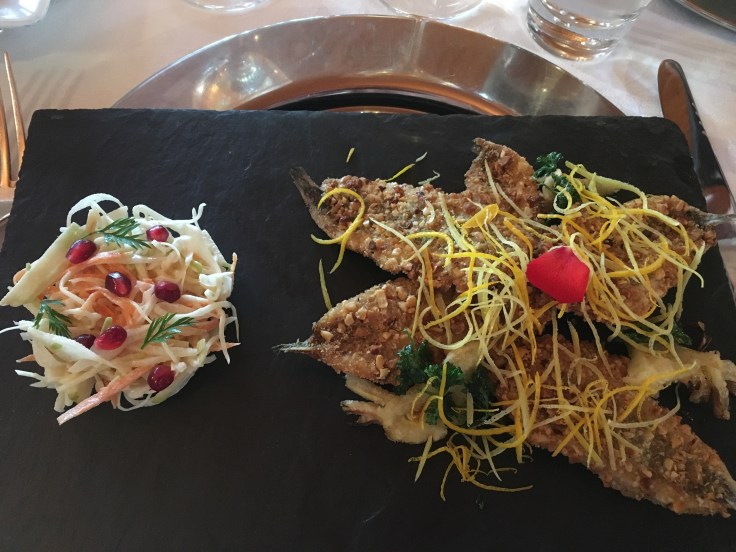
For my starter I had fresh anchovies that had been coated in chopped hazlenuts and then deep fried and served with crisp purple artichokes, thin slivers of lemon and orange peel and coleslaw.  It was fresh tasting with a pleasing citrus zing to it.

IMG_0981 2.jpg

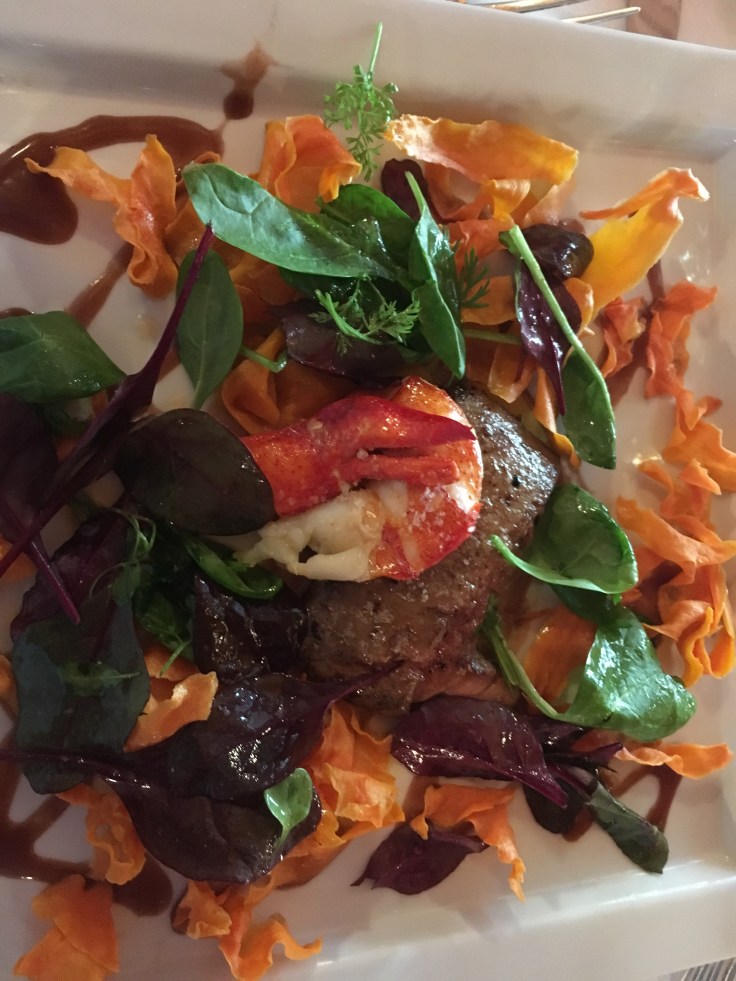
The main course was Lobster with pan-fried fresh foie gras.  Now these are two of my favourite things and in this instance they were very well cooked and presented, being served with crispy slivers of deep-fried  sweet potatoes and a few spinach leaves.  Delicious and colourful!

IMG_0982.jpg

Whilst the food was lovely there is something strange about how the place is run.  In short it doesn’t seem like a happy ship and that can spoil the entire effect.  At one point an almighty argument broke out in the kitchen which could be clearly heard throughout the room we were in.  Those with better Italian than I, described the language as being very colourful indeed. None of the waiting staff looked shocked by this so I can only assume its a fairly regular occurrence. I stopped eating Gordon Ramsey’s food years ago because of his nasty temper and I don’t want it anywhere else either.

How do you eat an elephant?

The Trebbia flows into the great River Po not far from Piacenza and was, in 1799, the site of one of Napoleon’s battles.  A little before then, in December 218BC to be precise, there was another Battle of Trebbia when Hannibal (with his elephants) and the forces of Carthage, fought the Romans in the second Punic War.

The river itself meanders through the Colli Piacentini (the Piacenza Hills) and the area features a number of small, pretty, villages, some with Castles, such as the Castello Rivalta, belonging to the family of the Dukes of Parma and Piacenza.  The family still lives in this imposing building and in 1993 it played host to their friend, HRH The Princess Margaret, sister of the Queen Elizabeth II.

To the question ‘how do you eat an elephant?’, one can answer, ‘bit by bit’ (poco a poco is to my mind at the heart of the Italian philosophy of life). So it was that after a ‘bit’ of tourism by visiting the castle, the other day, it came time for a ‘bit’ of lunch.  By happy coincidence Antica Trattoria Giovanelli, in the Borgo of Sarturano di Agazzano, was just a short car ride away.

I’d heard of this restaurant (which has been going since 1937) many years ago from a colleague who used to visit Piacenza on a regular basis and loved eating there.  When I came to live in Italy three years ago I was particularly happy to be taken there for the first time and even happier to return a couple of days ago.

Naturally, a good restaurant should serve good food and deliver good service (to say the least) but a really good restaurant adds a secret ingredient to that mix – a sense of well-being and contentment that comes from eating good food in a comfortable and convivial setting.  Giovanelli delivers this in spades!  As well as the food, about which more in a moment, it was wonderful to chat amiably with the family about mutual friends and English regional accents and to discuss, in immense detail, not only what food we wanted to order but how we wanted it served.  That doesn’t happen very often in fine-dining establishments!

And so to the food.  First and foremost this a restuarant which serves local specialities, that is, dishes that are traditional in the Piacenza area of Emilia Romagna.

We were three people for lunch and decided to share the antipasto and pasta courses and choose our own mains.  The anti-pasto was a generous plate of cured meats (salumi) with a few sweet pickled onions and cold frittata.  This selection was delicious, consisting of pancetta, coppa, salami and 36 month old culaccia. The healthy-food facists might condemn all of this stuff as ‘processed food’ and therefore evil but for me it’s processed, not only with salt but with love and dedication and is heavenly!  In this case its all matured in the cellars of the restaurant and much of it made following the recipes handed down from grand parents.

img_0884

We ordered two pasta dishes to share among the three of us.  Piserei e faso, are little dumplings (tiny gnocchi, the size of peas) made with flour and bread crumbs, served with a sauce of white beans and tomato.  It is a typical dish of Emilia Romagna and was soft, comforting and warming on a cold day.  Secondly and beyond description in its loveliness, was Toretelli di erbette e ricotta al sugo di porcini.  Now the porcini season is all but finished and for that reason I hesitated for a moment before ordering it.  In fact the porcini used had been dried, a way of preserving these rich tasting mushrooms that preserves their deep, complex and meaty flavour.  The top chefs of the world try, and sometimes succeed, in producing an element on a dish which they might call a foam or an air, that delivers an intense flavour and then almost as quickly vanishes in the mouth.  In this case the tortelli, stuffed with fresh ricotta and herbs were so soft and thin that when you put them in the mouth there was the briefest sensation of a bubble bursting, followed by an intense flavour rush  and the after taste of that slowly braised porcini  mushroom ragu.  Wow! Amazing!

Next up was one of my favourite birds, Faraona al Forno (roasted Guinea Fowl).  I love them so much because they remind me of the taste of chicken when I was a boy – not the bland taste of today’s intensively farmed varieties but something with flavour! In the finest traditions of the Italian kitchens the meat dish was just that, meat, nothing else.  We opted, in discussion with the waiter, to add a sauce of sweet peppers and Mostarda di Cremona, a northern Italian accompaniment to meat or cheese, made from large chunks of candied fruit in a mustard flavoured syrup.  It’s something I’m coming to appreciate the value of more and more as these Italian years roll by but despite its popularity I generally prefer the English style chutneys and other tracklements.  In this case though, the mostarda, made by  Ditta Augusto Fieschi which has been in operation since 1867, was very good.  The guinea fowl itself was perfectly cooked with a crispy brown skin and moist white flesh.

I’m not usually one for puddings but in this case I was determined to try something and chose a semi-freddo, crunchy with nuts.  As with everything else we’d eaten it was excellent but with hindsight I would have preferred to finish with a piece of Parmesan.

img_0893

Another thing to note about Giovanelli is that it serves wine in ceramic bowls rather than glasses, following the tradition of the area.  It’s quirky and gives the wine a lot of air but  they will provide glasses for the timid!

img_0885

Great Expectations

The weather here in Lombardy has been wet of late but as a break in the rain yesterday coincided with a completely free day for me, a friend and I drove to Reggio Emiglia, the county-town, as it were, of the Province of Emilia-Romagna.  It’s a pretty city of some 170,000 inhabitants and sits firmly in the agricultural zone where such delights as Parmigiano Reggiano cheese and Lambrusco wine come from.  A lot of the architecture is baroque, with attractive squares and arcaded streets.  On the road in from the autostrada there are three very modern road bridges by the renowned architect, Santiago Calatrava.Unknown-3.jpegUnknown-2.jpegUnknown.jpegThe railway station, by the same architect is equally striking.images.jpeg

This blog though is about food, not buildings, so let’s get back to the main subject.  I wrote here about the importance of expectations when it comes to defining my kind of food. It’s not acceptable to lead me to expect one thing and then deliver another.

We found a nice looking place to eat lunch yesterday, called Cadauno.  It had the appearance of a wine shop with bottles  adorning the walls and stacks of wine cases everywhere.  The menu was posted in the window and I was particularly attracted by a couple of interesting dishes.  Chianina (a type of beef) Hamburger with foie gras sounded appealing as did the Kobe beef sausage spiedini (skewers) in a spicy sauce.  They also had Loch Fyne salmon tartar on the list.  I was looking forward to engaging the waiter in conversation about where they source their Kobe beef in the hope of being able to lay my hands on some myself.

The welcome was somewhat muted but leaving that aside we found a table and ordered some water while we waited to choose food and wine.  The menu arrived on a blackboard and I searched it in vain for the dishes which had so attracted me only a couple of minutes before.  On enquiry of the glum waitress we were told that the menu in the window is for evening service and lunch should be chosen from the blackboard.  The allure of Kobe beef, even if only in the form of a sausage had seized me and I was very disappointed that it now seemed very unlikely that I would get to try it.  The things on the blackboard were fine and if that’s all I’d seen I would’ve been happy enough but my expectations of eating either Kobe or foie gras were raised.

We explained the problem.  The waitress, without hesitation, brought us the full menu so once again my gastric juices flowed in anticipation.  We ordered starters and mains, including the two previously mentioned dishes, they were written on the pad, the menus were gathered up and the waitress plunged into the depths of the kitchen only to return a few minutes later to tell us we couldn’t have the main courses.

We had tried and failed to order the food they’d advertised on their window menu; now was the time to admit defeat.  We left with our expectations unfulfilled and somewhat  let down but still with the sneaking suspicion that we might’ve missed a notice on the menu in the window saying it was only available in the evenings (there was no such notice).  The staff apologised and suggested we might like to come back in the evening…

Our second and successful attempt to find food led us to Cantina del Carbone nearby.  Here the menu was a mix of Italian and mexican food – this seemed unusual and I guess it may be something to do with the personal preferences of the chef, or perhaps his or her nationality.

In any case there were plenty of interesting sounding things to choose from and the staff were welcoming enough.  We ordered pasta dishes to start.  For me it was spaghetti del carbone which included anchovies, mushrooms, tomatoes and parmesan.  The anchovies were the salted type and there were lots of them resulting in a really robust taste – too much for some I should think but I loved it its deep and salty flavour.

IMG_0864.jpg
My friend had casarecci ( a new pasta shape to me) in a creamy saffron sauce with rocket and torn bits of speck ham sprinkled on top.

IMG_0865.jpg

My companion, for his second course, choose Sandwich Cubano, which had originally interested me too.  The menu told us it would be a sandwich consisting of mojo pork (mojo being a spicy sauce from Cuba and other Spanish cultures), swiss cheese, smoked ham and tomatoes all served with ranch potatoes.

IMG_1980.JPG

The bread was quite well grilled (burned?) on the outside which ought to have indicated that it was nice and crunchy but apparently it was soft and ‘wet’ both inside and out.  He thought the pork a bit dry and certainly the potatoes were cold.  This dish was not the picture of loveliness of the other things we ate.  It’s a shame because I think it had the makings of something quite delicious but it simply didn’t deliver.

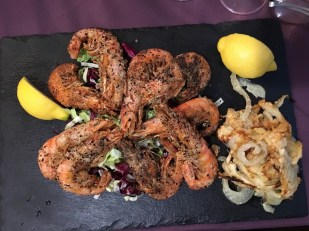
My second course was much nicer and was described as Gamberi al sale picante affumicato.  Big fat juicy prawns in a smokey, salty and spicy coating – they were messy to eat but absolutely delicious. They were served with a little salad of fennel and melted cheese, which I’m going to try cooking myself but I’ll served it warm not cold.

IMG_0866.jpg

I will go back to Reggio Emiglia one day and try to find other interesting places to eat.  Many bars seem to offer nibbles of parmesan cheese and the wonderful local hams and salamis so I think it’ll be a great place for an aperitivo too.

Deutschland, Deutschland über alles!

…well not when it comes to ‘my kind of food’, it’s not!

There’s been a bit of a hiatus in posting on the blog because I’ve been away, initially for a few lovely relaxing days in Bavaria and then two days in Tuscany.  Travelling is usually a fantastic opportunity to experience good food in great locations but alas that wasn’t the case in Germany and when I’ve had a chance to work out why that might be the case, I will share my reflections here.

On the other hand, Tuscany never disappoints.  Yesterday, three of us had Sunday lunch in a restaurant, called Ristorante Da Nilo  in Cetona, south of Siena.

IMG_0789.jpg

In fact we had meant not to eat there, having consulted TripAdvisor first and found a smattering of negative reviews that had been apparently rudely countered by the owner/chef, including the remark, ‘you don’t give sugar to donkeys’.  Confusion in organising the reservation, however, meant that we in fact booked into Da Nilo rather than the alternative we’d chosen in the same town.

img_0794

Once before, I chose to eat in restaurant that had poor reviews because the chef had answered them with supreme confidence in the quality of his own products and style of cooking and in that case I was not disappointed.  I have to say that was also true in this case too.

It was a cosy dining room, perhaps with more a provincial French feel to it than Italian and despite the initial welcome being less than enthusiastic, the vibe was good.

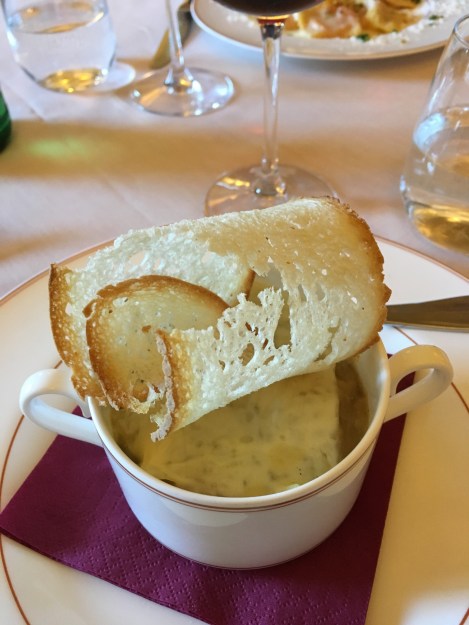
I choose the onion soup to start, which was deliciously sweet from the beautifully cooked white onions topped with a piece of fontina cheese, a semi-soft cow’s milk cheese from the Val d’Aosta, and a very fine bread crisp.  It wasn’t a runny onion soup, like the French do, but really thick with very little liquid discernible at all and could easily have been eaten with a fork instead of a spoon.

IMG_0797.jpg

Next up was Nodino di maialino al forno con arance caramellate e cuori di finocchi. This was a nice chunk of suckling pig with the subtle taste of caramelised oranges in the ‘gravy’ and a tiny portion of fennel and orange salad on the side.  The salad was so small I wondered if it was really necessary, but in fact it added so much to the dish in terms of contrast to the meat, that without it, the whole dish wouldn’t have been half so nice.  The meat was perfectly cooked, soft and juicy with a lovely crisp, salty crust.  I’d gladly eat this dish again.

img_0798

I’d say, if you’re in the area, this place is worth seeking out, despite some of the TripAdvisor comments.  As for Bavarian food, more later…..


Mama knows best

They say, if you ask any Italian to name the best chef in the world, the answer from everyone will be the same, “mama”.  Home cooking is held in very high esteem here, its the pinnacle of culinary experiences.

 Unknown-3.jpeg

There must be a reason why, in a country with some of the best ingredients in world and a population that lives and breathers food, there are relatively few so-called top class restaurants.  If you look in the Michelin guide (2016), there are only eight three star restaurants listed in the whole nation.  Of those only one is in the capital and none are in Milan, the business heart of Italy, where many of the richest Italians have homes.

I recently watched a documentary about the chef, Massimo Bottura, who owns Osteria Francescana in Modena (named this year as the best restaurant in the world in the San Pellegrino awards).  The programme showed that his early days in the restaurant were very much touch and go as Italians, perhaps especially the Modenese, were not that interested in eating what chefs today refer to as ‘elevated’ food.  Fine dining and Italian food were not natural bed-fellows.  If the inhabitants of my adopted homeland can’t eat Mamma’s food they seem to prefer eat at a local trattoria rather than a posh restaurant.  Tagliatelle al ragu depends on the quality of the pasta and the flavour of the rich sauce rather than on how it was re-intrepreted by the chef and refined beyond all recognition.

Don’t get me wrong, I once had the pleasure of eating at Osteria Francescana  and I loved it.  What Bottura does with local food is very exciting to me – but I’m not Italian.  My immersion into the culture of Northern Italy occasionally requires me to stop and take stock of things like, why there are so few posh eateries.

I also frequently wonder why there are some many Asian restaurants,  usually serving a fusion of Chinese and Japanese dishes.   There are three or four even in our little city of Lodi and two of them I know quite well.   I ate the other evening in Kokoro, which has recently changed its menu to focus more on Japanese rather than Chinese dishes.  I know very little about Japanese food but I really enjoyed what I had.  They’ve really managed to pack flavour into their food and combine a whole range of textures into every mouthful.  It’s clean tasting food and as different from Italian as you could imagine.

Unknown-1.jpegUnknown-2.jpeg

The restaurant was full, even on a Wednesday, and not only full, but full of Italians.  These were people choosing to eat Asian cuisine, in a  relatively smart restaurant, certainly ‘posher’ looking than most local Italian places. You’d never see the same people in an equally smart Italian restaurant, even if you could find one. It’s been suggested to me that the locals prefer mama’s cooking  and when that’s not available they’ll go the trattoria.  When they want something a bit different they eat Asian food or McDonalds; all of this in preference to Italian fine dining.  Only in Italy!


Bread and Dripping at Trembling Bridge

Pontremoli-Stemma2.pngPontremoli (literally ‘Trembing Bridge’) is a small town in the Massa-Carrara province of Tuscany, close to the Ligurian city of La Spezia.  Carrara, of course, is the place where the great artist, Michelangelo came to select the marble he used for his sculptures.
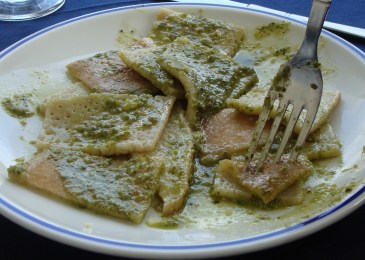
Like most places in Italy it has its own particular dishes, such as torta d’erbe which is a pie made with filo-type pastry and filled with chard, ricotta, eggs and parmesan cheese.  Also famous in this area is testaroli which is the oldest form of pasta known.  It’s a flat, baked pasta cut into small rectangles and commonly served with pesto.

Testaroli-Pesto-Pontremoli-2800.jpg
Testaroli con pesto

The afore mentioned chard is called bietola in Italian and tucked away in one of the tiny alleys of Pontremoli, is a lovely place to eat, Osteria della Bietola.  It’s a small family run establishment and I had Sunday lunch there recently.  The entrance to the kitchen is right by the front door and on arriving it was heartwarming to see the cook bending down and tending to something in the oven with steam and the smell of meat tumbling out of the open oven door before her.  She raised her head to shout a cheery ‘buongiorno’ then returned to her cooking.

The menu consists of a few antipasti, pasta dishes then meat (lamb, beef and rabbit as I recall) cooked in different ways, such as grilled, fried or ‘alla cacciatore’ (a gutsy stew).

11539627_10153471224835917_4800278658195994167_n.jpg
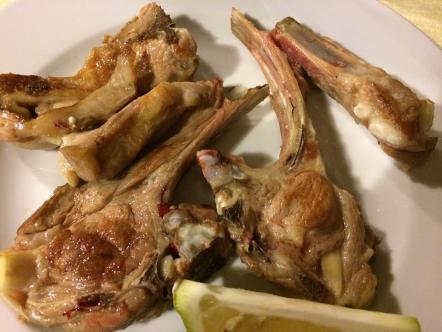
Grilled lamb chops with squeeze of lemon

For the pasta course I choose homemade ravioli stuffed with bietola and ricotta in a gorgeous meaty ragu.  I followed it with grilled lamb chops accompanied by a plate of soft white beans.  Extremely simple and perfectly tasty!

The highlight though was what came before (the antipasti).  There was some of the torta d’erbe mentioned above, various local cured meats and that most sublime of Italian foods, lardo.

Quite simply, lardo is pig fat that has been cured with salt, herbs and spices.  The best of it comes from Colonnata, which is a district of the city of Carrara.  The fat is traditionally cured in basins made from the famous Carrara marble and it has a long history going back to the days of the Romans.

Unknown-1.jpeg
Lardo di Colonnata

The lardo is sliced very thinly and eaten with bread and can be delicious, as it was on this occasion.  If the bread is warm then the experience is taken to new heights as the fat slowly melts.  It has other uses too, which might be the subject of future posts.  At home I serve it on warm gnocchi fritto, which are puffed up, deep-fried pastry ‘pillows’.  It’s a perfect combination which reminds me of Sunday night suppers as a child, eating pork fat spread on bread, or standing by the oven dipping bread into hot beef-dripping as the Sunday roast rested.

Unknown-2.jpeg
Gnocchi fritto con lardo

If you’re in Pontremoli, give this place a try – its cheap, cheerful and serves perfect home-cooked food.

Address: Via Bietola, 4, 54027 Pontremoli MS, Italy
Phone: +39 0187 831949


Found in a backstreet

img_0505

I had to be in an area of Tuscany called Lunigiana recently and decided to stay the night in the port city of La Spezia, nearby.  In fact it’s not in Tuscany but Liguria.  I was arriving late on Saturday afternoon and would leave early on Sunday morning and hadn’t made any arrangements for eating.  The accommodation I’d booked was well away from the seafront and in fact was in a fairly dull backstreet.  There was no one there when we arrived so it was necessary to wait until someone could come to let us in.  It was then that we noticed a sign indicating an eatery just two doors away (Osteria della Corte).  I wasn’t hopeful, but it had been a busy day and I didn’t have much enthusiasm for traipsing around the streets looking for somewhere to eat later, nor indeed could I be bothered with doing any research on-line.  Somewhere to eat and then get quickly back for a sleep seemed not a bad idea.

On enquiry, it seemed the restaurant was fully booked for dinner but with a little bit of persuasion and the offer to come late, the possibility of a table for two but, “not before 9.30 pm” materialised.  In the meantime a quick look at Trip Advisor and the Michelin Red Guide raised expectations well beyond what was indicated by the location or the exterior of the restaurant.

The initial welcome was from a young waiter who greeted us with a pleasant smile and showed us to our table. The smells from the small kitchen were enticing.

We asked immediately for a bottle of sparkling water while we perused the menu.  The waiter meanwhile busied himself reducing the table setting from a table for four to the needs of two diners.

The menu was very interesting and one where I really found it difficult to decide what to order.  I wanted most of the things on offer!  It was divided into Antipasti, Primi (pasta dishes) Il mare (fish and seafood) and La terra (meat, snails, liver and a vegetarian dish).  The dining room was intimate and well decorated with shelves bearing cookery books and a vast array of bottles of wine.  There was a sideboard with spare sparkling wine glasses in various shapes and sizes next to bottles of delicious looking dessert wines.

With the table re-set for two and our choices made, we wondered what had happened to the water.  The tiniest of gestures to the waiter produced a fulsome apology, followed immediately by the required beverage. I’ve never had a problem with things going wrong in restaurants, it’s normal; the main issue is how quickly, to what extent and with what attitude things are put right.

img_0512

With the order taken, wine chosen (something local, red, well priced and very acceptable) we began to observe the other diners and in particular the dishes they were being served.  Everything looked amazing and the sight of such good looking food made me want to change my own order a dozen times.

I stuck to my guns though and soon three beautifully caramelised scallops (Capesante)  on a courgette and thyme cream (ordered from the Antipasti list) arrived.  They were very simple, succulent and perfectly cooked.


img_0513

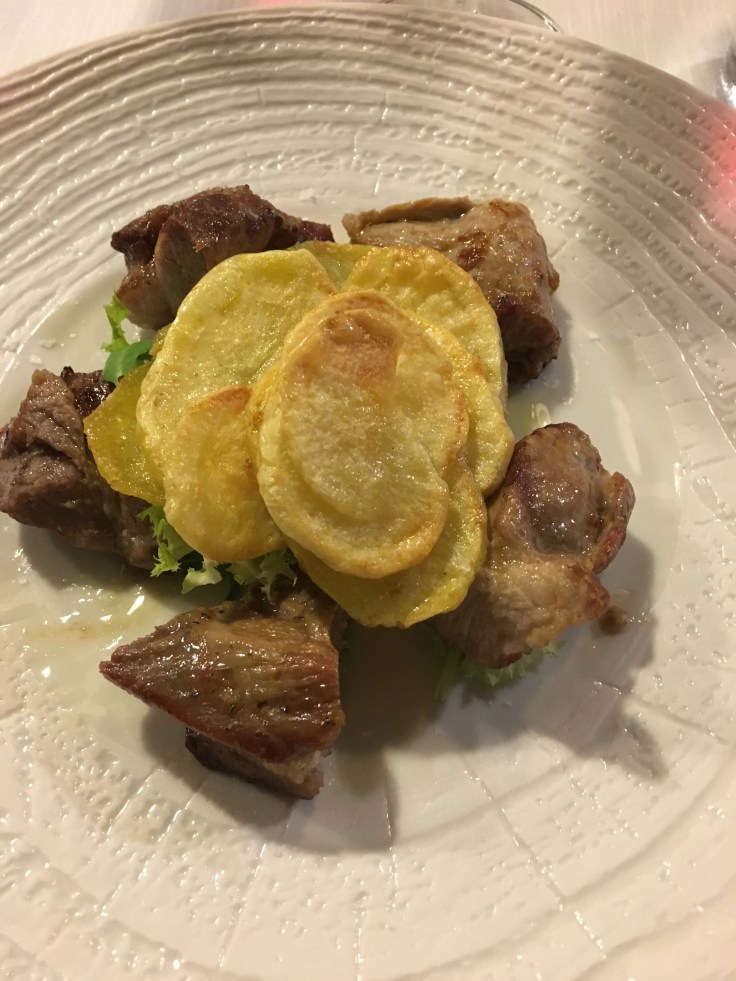
My next dish was from the meat section of the menu, Taglio di maialino di Cinta senese con patate (suckling pig with potatoes).  Cinta di senese, I now know, is a particular breed of pig from the province of Siena and in this case was served it chunks topped by sautéd potato slices.  The meat was beautifully pink in the middle but with equally delicious crunchy bits around the outside, clearly cooked with careful attention.  For my taste the potatoes were a little dry and the meat a little over salted but it tasted properly of meat and with the sort of texture it’s impossible to achieve with the uber fashionable sous-vide method of cooking.


img_0515

For pudding I had a confection of  frozen cream (parfait) with Sichuan pepper, coconut, and liquorice  sauce which was served with a glass of perfectly matched  Passito – faultless!


img_0517

The front of house staff here (two guys) were very keen to hear feedback and and not at all defensive in the face of what I told them about the over-salting of the meat.  They genuinely seemed interested in what we thought and discretely and generously did what they could to put things right – even though we were at pains to point out that we were not complaining.  In any case what minor grumbles I had didn’t stop me scoffing the lot!

I have a number of pet hates when it comes to service in restaurants, one is when waiters who haven’t kept your glass topped up (in any case I can manage that myself) rush to grab the bottle from your hand when you try to help yourself (that wasn’t the case here by the way) and the other is the wearing of gloves by waiting staff.  Here, white gloves were donned whenever the guys brought cutlery or glasses to the table.  Sure it meant everything was gleaming but in my view it’s a tad fussy.

Prices for starters  and pasta are around €15, fish mains about €20 and meat a little bit more with deserts coming in at around €7.  Whatever the cost they represent very good value for money.

Here is a restaurant that has worked out exactly what it is about and strives to deliver high standards of cooking and service in a very pleasing environment.  Inevitably there are occasional errors but they acknowledge them and put them right without question. That’s a very big plus point in my book.

The staff speak good English and Silvia, the chef, also runs cookery courses.  I will return, not only because of their food but because of their attitude.


img_106026-1.jpg

Down with stuffed crust!

images
Real Pizza

Food in Italy is very regional, by which I mean that each region has its own particular dishes and those dishes which traditionally can be found all over the country have regional variations. But it’s not a free for all! Anyone who has visited different parts of Italy will know that, for example the shape of the pasta changes quite markedly.  Also the further South you go the less likely it is that you will find traditional cooking using butter and the further North the more likely it is that creamy (usually unsalted) butter is used in preference to olive oil.

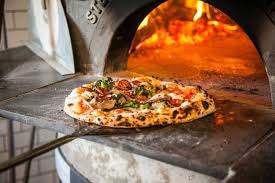
Pizzas can be found all over Italy, indeed all over the world.  The breaking news is that they were not invented in Chicago but in the south of Italy (Naples or thereabouts) and the first documented proof of their existence goes back to the 10th century AD where they are mentioned in a Latin document from the Southern town of Gaeta.  This simple flat bread dish has a noble heritage and is deserving of respect.  Good pizza chefs produce a superbly thin base with traditional toppings.  They do not stuff the crusts with plastic cheese or scatter tinned pineapple chunks on top.

There are other well known Italian dishes that are equally badly treated as they are ‘re-interpreted’ in the mass production kitchens and fast food restaurants of the world.

images-2
Guanciale

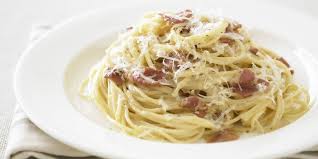
Carbonara is the one that most easily springs to mind.  It’s best known as Spaghetti alla Carbonara but as it’s a dish that has its origins in the Lazio region (Rome in fact) it’s often served there with Fettuccine.  There are ingredients in the sauce. FOUR! They are:  Eggs, bacon (about which more in a moment), black pepper and cheese.  That’s it.  No mushrooms.  No cream. No garlic. No Nutmeg.

Even Nigella Lawson gets it wrong but a receipt uploaded by a Jamie Oliver fan to his website is quite good.

images-1
Pecorino Romano

There is some legitimate variation about those ingredients but frankly there’s no room for adding anything else.  The eggs can be yolk and white together, just yoke or all of the yolks and some of the white.  As for the bacon; its important to note that ‘bacon’ in Italy is different to what we know as bacon in the UK.  Try making a bacon sandwich with Pancetta!  It’s very nice but it’s simply not right.  For Carbonara there are two possibilities when selecting the ‘bacon’.  The preferred option, in my opinion, is to use cubes of pancetta, making sure there is some fat for flavour.  The alternative is a similar looking ingredient called guanciale.  Guanciale is another bacon-like product made the from the cheek of the pig (guancia being the Italian for cheek) and is the meat traditionally used in another pasta sauce, amatriciana.  Coarsely ground black pepper, and lots of it, is key to the Carbonara sauce.  Whilst the origin of the name of the sauce isn’t certain we can be sure it relates in someway to carbon so it’s important that the pancetta is well fried and has lots of little black bits and the pepper not so finely ground so it too can be seen in all its black beauty.  These two together represent the carbonesque nature of the dish.  The cheese should properly be Pecorino Romano a sheep’s milk cheese, coming from the same area as the dish itself, with a lovely salty taste .

The sauce in Italy is a coating for the pasta not a sloppy soup for the pasta to sit on or under and this one in particular is quite dry.  If it’s too dry you can stir a spoonful or two of the pasta cooking water in to loosen it a bit.

unknown-1
Spaghetti alla Carbonara

Ingredients (4 people)
300g dried Spaghetti
150g cubed pancetta or guanciale
6 free range egg yolks (or 4 whole eggs)
100g of Pecorino Romano finely grated (or substitute Parmigiano Reggiano or Grana Padana)

Method
Bring a large pan of water to the boil, add a good pinch of salt and cook spaghetti accruing the instructions on the packet. Don’t overcook the pasta and should have a definite ‘bite’ and not be too soft.

Meanwhile fry the pancetta in a large frying pan until its nicely browned.  Removed the pan from the heat.

Beat the eggs in a bowl and add 2/3rds of the cheese and lots of coarsely ground fresh black pepper.  Mix it all together and set aside until the pasta is cooked.

Drain the pasta, reserving a cup of the pasta water.  Add the pasta to the frying pan (which should off the heat) and pour the egg mixture on top.  Quickly combine the pasta, the pancetta and eggs until the pasta is evenly coated.  If you delay the eggs may well scramble. In fact it should become lovely and creamy (without adding cream!).  If it seems a bit too dry, then add some or all of the reserved pasta water.

234738731Serve immediately with the remaining cheese sprinkled on top and if necessary a few more turns of black pepper.

NB.  Eggs differ from one another and spaghetti comes in slightly different
thicknesses so you may have to experiment until you find the right method for your ingredients but never ever add cream or if you do, don’t call it Carbonara!

Blog at WordPress.com.

Up ↑