As quite a lot of the content of this blog is likely to focus on the regional food of Italy, I thought it might be useful to post a map. I found it here.

As quite a lot of the content of this blog is likely to focus on the regional food of Italy, I thought it might be useful to post a map. I found it here.

Grana in Italian means ‘grain’ and when it comes to cheese it refers to the grainy texture of cheeses like Parmesan (not the sweepings from the factory floor and sold in the UK in cardboard tubes, but the real thing!).
Grana is a hard cheese and made in huge ‘wheels’ weighing between 24-40kg each
The Pianura Padana is the great flood plane of the River Po in Northern Italy and is the area where Grana cheese is made. It was originally created by monks almost a millennium ago and by the 15thC was one of the most famous cheese in Italy. Nowadays it is protected by EU law with a PDO (Protected Designation of Origine) classification and in Italy, since 1955 by a DOC (Dominazione di Origine Controllata). Prior to 1955 Grana was known by various different names depending on where it was made. Grana Lodigiano, Grana Emiliano, Grana Lombardo and Grana Veneto were some of the variants. Now though, the generic term Grana Padano is used. Typically the cheese, made from cows milk, is matured for 9 months (Grana Padano), over 16 months (Grana Padano oltre 16 mesi) or over 20 months (Riserva). Each year about €750M worth of Grana Padano is exported around the world.

Parmesan cheese (Parmigiano-Reggiano) is matured for longer (up to 36 months) and is protected by its own DPO and DOC and has a more complex flavour structure than Grana Padano. Its not correct, as some have reported that Grana Padano is an inferior product or is the cheese which doesn’t make the grade as Parmigiano Reggiano.
They are similar but distinct products.
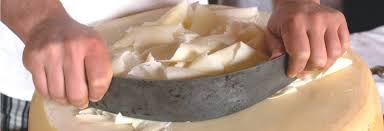
Here in Lodi, in Lombardy, locally produced Grana Padano (Grana
Lodigiano, if you like) is used to create a local delicacy, Raspadura. It is made by scraping a long flexible blade across the cut face of a Grana wheel in order to remove gossamer thin
shavings of cheese. This works especially well with the less mature cheeses (9months) and is eaten as a snack or with an aperitivo.

When people ask me to tell them what is my favourite restaurant I hesitate for two reasons. Firstly I hate the ‘favourite’ type questions such as what is favourite colour, music, TV programme and secondly, how to decide. Always for me the answer has to be ‘it depends’.
There are restaurants tha t I return to time after time, or would if I could, so I suppose they could in some way be classed as favourites. The first of those is a restaurant in London where I first went 15 years or more ago. Le Caprice is legendary in certain circles and has been around in one form or another for 35 years with a host of celebrity, royal and hip clients. For sure the former husband of the Queen’s late sister could always be certain to get the best table but Le Caprice serves its ‘ordinary’ regulars exceptionally well too. After only my first couple of visits I was always ‘known’ and my Bloody Mary preferences always anticipated. The food is a fusion of modern American, British and European cuisine, the service friendly and relaxed but uber efficient. It’s not cheap but it’s not too expensive either (this is Mayfair!) but it is consistently good and I miss not being able to go as often as I used to do.
Over the years I’ve eaten in one or two of Rome’s ‘best’ restaurants but have always, in some way, left feeling disappointed because they never quite lived up to my high expectations. The higher the price the higher the expectation is my thought. Trattoria da Luigi though has hardly ever disappointed. It has no pretensions whatsoever. It is what it is, a simple family run Roman trattoria frequented mostly by Romans and those visitors to Rome who like me have been eating there for decades. My first visit was probably 30 years ago and every visit to Rome since then has had to include one, two or even three return visits. The staff are always welcoming and whilst the food could never be described as ‘fine dining’ it is undoubtedly fresh local food cooked well and served with enthusiasm. I’ve seen the generations of the family grow up in the business and work hard to ensure that nothing much changes from year to year. Perhaps occasionally the umbrellas or table lines are replaced or the wall re-painted but the abbacchio al forno or the fiori di zucca stuffed with mozzarella and anchovies remain delicious.
A relatively recent addition to my list of places to return to requires a bit more commitment in terms of cash and advance booking. Osteria Francescana in Modena is owned and run by Massimo Bottura in the streets where he grew up as boy. He’s a remarkable chef with a social conscience. During Expo Milan in 2015 he organised Refettorio Ambrosiano to ensure that the chefs working at Expo didn’t forget the poor by using their talents and excess produce to feed the poor. Osteria Francescana is Number 1 in the World’s 50 Best Restaurants 2016 and boasts three Michelin Stars. “Our Cooking is collision of ideas, cultures techniques and gestures” says their website. For me my dinner there was visually challenging – one of the presentation techniques is to throw the food onto the plate – and deeply rewarding in terms of flavour and especially the combination of flavours.


To the north-east of the centre of Milan is a Michelin 1 star restaurant called Innocenti Evasioni where I recently had dinner to celebrate a friend’s birthday.

Sometimes the fact that a restaurant’s front door is difficult to find is a portent of hidden treasures to be discovered. In this case the door was also locked and it was necessary to ring the bell. Was this also a sign of exclusivity and privilege? It had been the same at the best restaurant in the world, Osteria Francescana in Modena and the Red Door in North Hollywood; or was it the case that arriving as we did at exactly 8pm, they weren’t quite ready for service? Time would tell. The door was quickly unlocked by a guy in chefs whites – really? He was very welcoming and showed us to our table. We were the first to arrive and indeed the staff were still putting the final touches to the tables.
Things soon settled down, menus were brought, and nice sharp Franciacorta aperitivo served together with the most delicious grissini. To my mind they were what I would call cheese straws, a sort of long thin version of the best cheese scone it would be possible to imagine. They were loaded with cheese and butter flavours yet still crisp and crumbly. I could easily have a made a meal of them and almost did as more were offered.
The dining room was long room with all round tables, perhaps a little bit too close together, especially as the next able consisted of an Italian couple being bored to death by a very loud English guy giving them the benefit of his business knowledge. This in contrast to the peace and stillness of the Zen garden on the other side of the windows.
A decision was made to order the tasting menu. In this case it was a modest one of 5 courses at a very reasonable price of €68 with optional wine pairings that would have cost a further €25. We opted for a bottle of red from a wine list with a decent range and very reasonably priced and in may case copious amounts of water as I had to drive.
As the first course arrived i remained a little worried that the chef who had let us in half an hour earlier still hadn’t gone to the kitchen. Who then was cooking? Mama? Nonna? Was it a regeneration kitchen with lots of steam ovens to reheat bought-in food? All  sorts of things go through the mind when apparently the chef is in the wrong place! Well it turns out, although I didn’t discover this until the next day, that the restaurant is owned by two chefs and one of them (Eros Picco) therefore could well have been at the stoves. Tommaso Arrigoni (a TV chef) is the front of house guy and responsible for buying the wines. All good but I would not have been so anxious if he hadn’t been dressed for the kitchen.
I needn’t have worried about who was cooking. Each course, even if the individual ingredients couldn’t always be identified on the plate, represented a masterful amalgam of flavours. The astice carpaccio consisted of barely cooked lobster with cardamom, mango, wafer thin celery, rocket and gin jelly. Next, the duck foie gras terrine was the only disappointment of the evening and then only because it was a bit pedestrian compared with the other dishes. The toasted brioche with which it was served seemed dry.
Stinco di vitello (veal shin) was stuffed into little ravioli and served with saffron flavoured buffalo cream, broad beans and crystallised sage leaves – heaven! This was followed by loin of Iberian pork with star anise flavoured carrot puree and caramelised red onions. The pork was lovely and pink with a slightly caramelised outside and with the most amazing salty taste. The texture though was bit strange, probably because of the use of the ubiquitous water-bath. I’m coming to dislike sous-vide cooking. A good chef should be able to cook meat by eye.
Dessert, not normally my favourite course at any meal, was simply gorgeous and not too sweet. Listed as Caramelised Millefuille, it was gorgeous puff pastry with chocolate, mango puree and the star ingredient, goats cheese ricotta which added a slightly salty tang to contrast the caramel glaze on the pastry. A perfect combination!
 My Kind of Food